
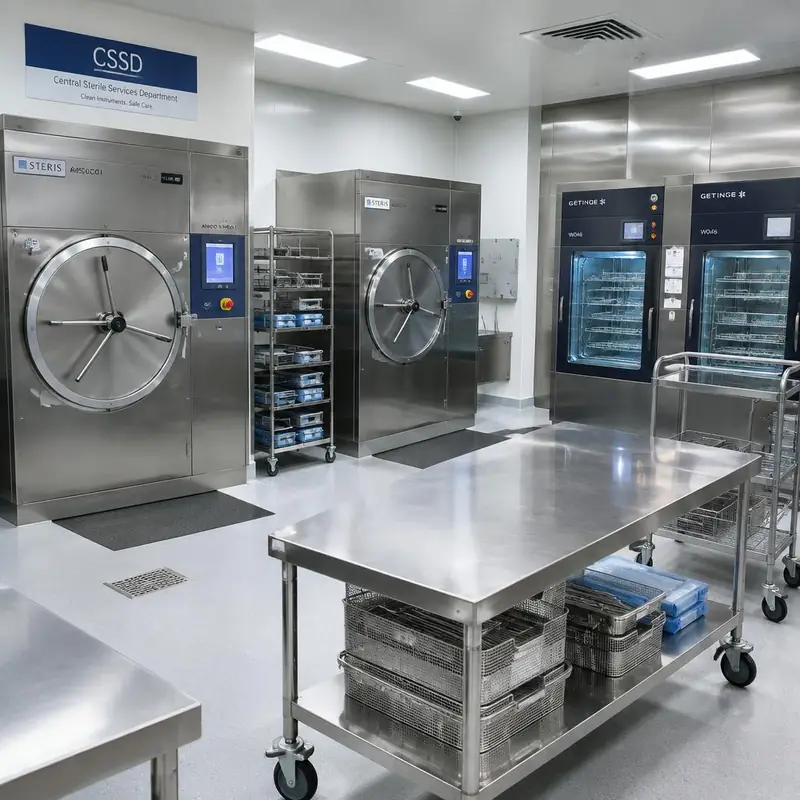
Every surgical instrument, dressing tray and reusable device used in a hospital has to be cleaned, checked, packed and sterilised before it touches the next patient. In most hospitals this work is done in one place: the Central Sterile Services Department, usually called the CSSD. It is rarely seen by patients, yet the operation theatres, ICUs, labour rooms and wards all depend on it every day.
This guide explains what a CSSD is, what happens inside it, how it is laid out, which equipment it uses and what hospital owners, administrators and planners should think about when building or upgrading one. It is written for people planning a new facility or improving an existing one, not as a substitute for the infection-control standards and guidelines your hospital follows.
What does CSSD stand for?
CSSD stands for Central Sterile Services Department. You may also see it called CSSU (Central Sterile Supply Unit), SPD (Sterile Processing Department) or simply the sterilisation department. The names differ, but the idea is the same: instead of each department cleaning and sterilising its own instruments, the hospital centralises the work in a single controlled area with trained staff, proper equipment and documented processes.
Centralisation matters because sterilisation is not just about putting instruments in an autoclave. It is a chain of steps, and a weak link anywhere in that chain can undo the rest. A dedicated department makes it easier to control each step, train people properly, maintain equipment and keep records that show what was processed, when and how.
What does a CSSD actually do?
The core job of a CSSD is to receive used items, make them safe and return them ready for use. In practice this covers several distinct activities:
- Collecting used instruments and devices from the operation theatres, wards, ICUs and other departments.
- Sorting, cleaning and decontaminating them, manually and with washing equipment.
- Inspecting each item for cleanliness, damage and correct function.
- Assembling instrument sets and trays, then packing and labelling them.
- Sterilising the packed items using a method suited to the material.
- Storing sterile items under controlled conditions and issuing them to departments.
- Keeping records so each set can be traced back through the process.
Some CSSDs also manage linen packs, dressing drums and supplies for specific departments. The exact scope depends on the size of the hospital and how it chooses to organise its services.
The one-way flow: dirty to clean to sterile
The most important design principle in a CSSD is one-way flow. Used, contaminated items should move in only one direction, from the dirty area through cleaning and packing to the sterile store, and never travel back the way they came. Clean and sterile items should never share a path, a counter or a trolley with contaminated ones.
This principle shapes the whole department. It decides where the doors go, where the washers and sterilisers sit, how staff move between areas and where trolleys are parked. Many sterilisers and washers used in CSSDs are double-door units built into a wall: dirty or unsterile items are loaded on one side and removed from the other, so the machine itself becomes part of the barrier between zones.
Pass boxes play a similar role for smaller items. A pass box is a cabinet set into a partition wall with interlocked doors on each side, so items can move from one zone to the next without staff walking between them or both doors being open at the same time.
The main zones of a CSSD
Although layouts vary, most CSSDs are divided into a sequence of zones that follow the one-way flow.
1. Receiving and decontamination (dirty) zone
This is where used items arrive. Staff wear suitable protective equipment, sort instruments, dismantle them where needed and begin cleaning. Typical fittings include deep sinks, pre-cleaning stations, ultrasonic cleaners, washer-disinfectors and drying equipment. Because this area handles contaminated items, it needs washable surfaces, good drainage, adequate ventilation and a layout that stops dirty items or staff from straying into clean areas.
2. Inspection, assembly and packing (clean) zone
Cleaned items pass into the clean zone, often through the washer-disinfector itself or a pass box. Here staff inspect each instrument under good lighting, sometimes with magnification, to check that it is clean, undamaged and working. Instruments are then assembled into sets according to checklists, wrapped or placed into containers, and labelled. Work tables, instrument racks, packing materials, sealing machines and labelling systems belong here.
3. Sterilisation zone
Packed items are loaded into sterilisers. Steam sterilisation with autoclaves is the most common method for heat-tolerant items. Heat- or moisture-sensitive devices may need low-temperature methods, such as those based on ethylene oxide or hydrogen peroxide, which have their own space, ventilation and safety requirements. Each cycle is monitored, and indicators are used to confirm that conditions were met.
4. Sterile storage and issue zone
Sterile items are unloaded, allowed to cool and moved to a clean, dry, controlled storage area. Shelving should keep packs off the floor and away from walls, with first-in, first-out rotation. Issue to departments is usually through a separate window, hatch or pass box so that sterile goods leave the department without crossing the dirty side.
Supporting spaces, such as staff changing rooms, a supervisor's office, a store for consumables and, in larger facilities, a trolley wash area, sit around these core zones.
Key equipment in a hospital CSSD
The exact equipment list depends on the hospital's size, case mix and chosen processes, but most departments will need some combination of the following:
- Sinks and pre-cleaning stations for manual cleaning and soaking.
- Ultrasonic cleaners for instruments with joints, hinges or fine detail.
- Washer-disinfectors for automated, repeatable cleaning and thermal disinfection.
- Drying cabinets so instruments are fully dry before packing.
- Inspection tables with task lighting and magnifiers.
- Packing tables, wrapping materials, containers and heat sealers.
- Steam sterilisers (autoclaves) and, where needed, low-temperature sterilisers.
- Pass boxes and double-door units between zones.
- Sterile storage racks and closed transport trolleys.
- A tracking and record-keeping system, on paper or software.
Rather than buying equipment item by item, it usually pays to plan the department as a whole. The equipment, the room sizes, the services (water, steam, drainage, electrical load, ventilation) and the flow all affect each other.
How the CSSD connects to the operation theatre
The operation theatre complex is normally the CSSD's biggest customer. Instrument sets go out to the theatres, come back after surgery and must be turned around in time for the next list. That makes the relationship between the two departments a planning question in its own right.
Some hospitals place the CSSD directly next to or below the theatre suite, connected by dedicated clean and dirty lifts or corridors. Others locate it further away and rely on closed trolleys and scheduled collections. Either can work, provided clean and dirty movement is kept separate and transport times are realistic for the theatre schedule. When a hospital is planning modular operation theatres, it is worth planning the CSSD route at the same time instead of treating it as an afterthought.
Planning a new CSSD or upgrading an existing one
Whether you are building a new hospital, adding theatres or improving an older sterilisation room, a few practical questions will shape the project:
- Workload: how many theatres, procedures and departments will the CSSD serve, now and in the next few years?
- Scope: will it handle only theatre instruments, or also ward items, linen and dressings?
- Space: is there enough area for separate dirty, clean, sterile and storage zones with a true one-way flow?
- Services: are water quality, drainage, power, steam and ventilation adequate for the equipment you plan?
- Location: how will items move between the CSSD and the theatres, ICUs and wards?
- Staffing and training: who will run the department, and how will procedures be documented?
- Standards: which national guidelines, accreditation requirements and manufacturer instructions apply to your hospital?
Answering these questions early helps avoid common problems, such as cramped rooms where dirty and clean work overlap, sterilisers installed without the right services, or storage that is too small for the number of sets in circulation.
Common mistakes to avoid
A few issues come up again and again when sterilisation areas are planned in a hurry:
- Treating the CSSD as a single room with an autoclave rather than a sequence of zones.
- Allowing clean and dirty trolleys or staff to share the same corridor or door.
- Choosing equipment before confirming room sizes and building services.
- Leaving too little space for inspection and packing, which is where many errors are caught.
- Underestimating sterile storage needs.
- Skipping documentation, which makes it hard to trace a set if there is ever a problem.
Final thoughts
A well-run CSSD protects patients, supports surgeons and keeps the operation theatres running on time. Its success depends less on any single machine and more on a sensible layout, a strict one-way flow, suitable equipment and trained staff following clear procedures.
If you are planning a sterilisation department as part of a new hospital or a modular OT project, Unicare Medical Solutions can discuss CSSD systems, pass boxes and related hospital infrastructure with your team. Share your drawings and requirements and we will respond with options suited to your facility.