
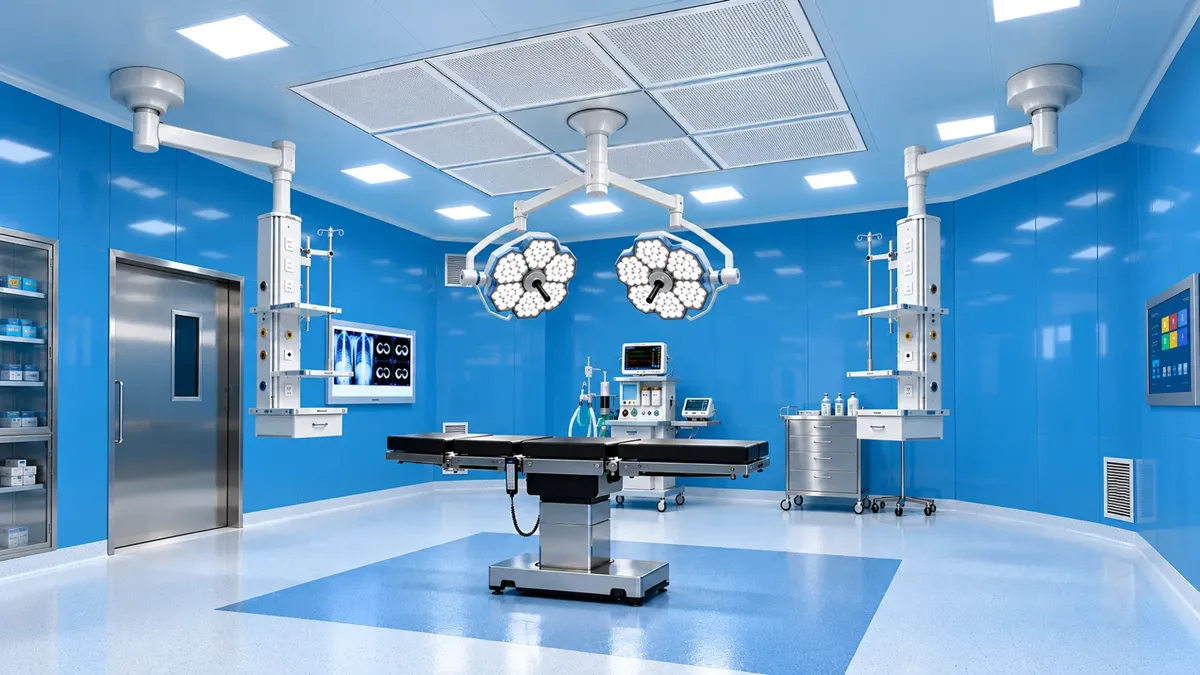
Delhi NCR has one of the densest concentrations of hospitals in India, from large corporate hospitals in Delhi and Gurugram to nursing homes in Ghaziabad, Noida and Faridabad. Many of them are adding or upgrading operation theatres, and there is no shortage of companies offering to build them. Choosing the right one is harder than it looks.
This article sets out a practical way to compare [modular operation theatre manufacturers](/products/modular-operation-theatre) in the region. It focuses on questions you can ask and evidence you can check, so that you choose on substance rather than on a brochure or the lowest headline price.
Start with your own brief
A good comparison starts before you call any supplier. Write down the number of theatres, the surgical specialities, whether it is a new building or a running hospital, the room sizes and ceiling height, and your target date. Note any accreditation plans, such as NABH, and who your HVAC and electrical consultants are.
With this brief, every supplier quotes against the same requirement. Without it, each one quotes a different scope and the numbers cannot be compared.
Manufacturer or trader?
Some companies manufacture their own panels and frames; others buy and resell. Both can deliver a theatre, but a manufacturer controls panel quality, sizes and lead times directly, and can make changes when the site needs them. Ask where the panels are made and whether you can visit the works or see samples.
In Delhi NCR this is easy to check because distances are short. Our own works are in Ballabhgarh, Faridabad, and hospitals can review panel samples, door hardware and control panels by appointment.
Check what the quotation actually includes
Quotations for a modular OT vary widely in scope. Ask each supplier to list clearly whether the following are included:
- Wall and ceiling panels, with material, thickness and finish.
- Hermetic sliding doors and their operation (manual or automatic).
- Laminar air flow unit and HEPA filters, and where the supplier's scope ends and the HVAC contractor's begins.
- Surgeon control panel, lights, pendants and medical gas outlets.
- Storage cabinets, X-ray viewer, pass box and flooring.
- Dismantling of an existing theatre, site protection and debris removal.
- Testing, documentation, warranty and maintenance terms.
When scopes are listed side by side, the real difference between quotations becomes clear. Our [modular OT cost guide](/modular-ot-cost-india) explains the main price factors.
Coordination with HVAC, electrical and gases
An OT fails most often at the interfaces: ducts that do not line up with the laminar air flow plenum, pendants without gas supply, or electrical points in the wrong place. Ask who prepares the coordinated layout and who is responsible if systems do not fit together.
A supplier that also handles the [medical gas pipeline system](/products/medical-gas-pipeline-system) and coordinates with the HVAC team reduces the number of handovers between contractors. Single-point responsibility is one of the main reasons hospitals choose modular construction.
Working inside a running Delhi NCR hospital
Much of the work in Delhi NCR is refurbishment in buildings that stay open. Goods vehicles may be allowed only at certain hours, lifts and lanes can be narrow, and dust must be kept away from wards and other theatres.
Ask how the supplier will phase the work, seal off the work zone, move panels into the building and schedule noisy tasks. A supplier with a local presence can attend site meetings at short notice; our office is in Ghaziabad and our works are in Faridabad, so most NCR sites are within a short drive.
Testing, documentation and handover
Before you accept a theatre, it should be tested and the results recorded. Typical checks include air changes, pressure difference with the corridor, particle count, HEPA filter integrity, temperature and humidity, and medical gas purity and pressure. Ask which tests the supplier performs, which are done by the HVAC contractor, and what documents you will receive.
Good handover documentation, including drawings, test records and maintenance guidance, matters for daily operation and for any future accreditation assessment.
Warranty and after-sales support
Ask what warranty applies to panels, doors and the control panel, how service requests are handled and whether an annual maintenance contract is available after the warranty. Check how quickly a technician can reach your hospital and whether spare parts are kept.
For turnkey projects we offer an extended warranty of 18 to 24 months and AMC support for 5 to 7 years after the warranty ends.
Local pages for Delhi NCR
Each part of the region has its own building types and access conditions. Our local pages explain how surveys, delivery and installation work in each area:
- [Modular operation theatre manufacturers in Delhi](/modular-operation-theatre-manufacturers-in/delhi)
- [Modular OT manufacturer in Ghaziabad](/modular-ot-manufacturer-ghaziabad)
- [Modular OT manufacturer in Noida and Greater Noida](/modular-ot-manufacturer-noida)
- [Modular OT manufacturer in Faridabad](/modular-ot-manufacturer-faridabad)
- [Modular OT manufacturer in Gurgaon](/modular-ot-manufacturer-gurgaon)
A simple comparison checklist
Before you sign, score each shortlisted supplier on the same points:
- Own manufacturing and visible samples.
- Complete, itemised scope in the quotation.
- A coordinated layout with HVAC, electrical and gases.
- A clear plan for working inside your building.
- Defined tests and handover documents.
- Written warranty and maintenance terms.
- Local survey and service capability.
The supplier that scores well on all of these is usually a better choice than the one with the lowest price. To start a comparison, share your brief with our team, or read more about our work as [modular OT suppliers](/products/modular-operation-theatre).